Maybe I'm the only one, but no one ever seem to talk about what happens to your house when you spend all your time doing things like canning. Mine ends up looking rather like a tornado has passed through a farmer's market and a thrift store and deposited everything it sucked up on the way in my living room. You know you've been canning too much when:
- You start sterilizing a couple of extra pint jars with each batch just so you have a clean dish to drink wine out of while the jars are processing
- Your chickens have a look of terror in their beady little eyes every time you come out with another bowl of food scraps
- The fruit flies now outnumber the human residents to such an extent that the bills start arriving addressed to them instead of you
- That strange thumping in the hall is all three cats batting around tomatoes they've found god-knows-where, and your first reaction is a flash of icy-cold terror that you still have tomatoes somewhere in the house, and you don't know where!
- You're working in the kitchen all the time, but you haven't eaten anything other than sandwiches, instant mashed potatoes, or toast for the past six weeks because there's never a free burner to cook anything else.
- You start constructing molecular diagrams out of the hundreds of canning rings lying around just so their presence looks intentional
- Your efforts to disassemble the Jam Tower and actually put things away are thwarted by the city informing you that a project of this scope requires permits and a public input period.
- The cats are no longer afraid of the vacuum because they can't remember what it does.
One of these years I'll get the hang of all this juggling, I'm sure. Or at least I hope so, because my other option is to simply move to a new house every November. xD
Showing posts with label cooking. Show all posts
Showing posts with label cooking. Show all posts
10.09.2011

10.03.2011
Why We Bother
It was a light weekend so far as canning goes -- I only got 19 jars done: 13 pints of carrots, 5 quarts of sweet pickled crabapples, and 1 12-oz. jar of pickled cranberries with the leftover syrup from the apples. Of course there's more to do this week (35 pounds of grapes and over a bushel of red bell peppers to roast for red pepper spread), but we had other things to do over the weekend, so those bigger projects just had to wait. But, oh, the grape juice and pepper spread will be so worth it after I finally get around to them!


One of the things we did this weekend was go over to my in-laws' for dinner. Inevitably our latest canning projects come up in conversation when we do this, and equally inevitably we get questions like, "But wouldn't it be cheaper to buy X in the store?" (My MIL appreciates the non-monetary benefits of "slow food," but I think my frugal FIL and BIL think we're nuts!) I suppose that in a culture where the primary consideration for everything has shifted to whether it's sufficiently cheap, that's a fair question, but saving money is not why we do many of the things we do. (Or at least it's not the primary reason -- there are some things, like my herb-infused vinegars (below), that are a big savings to make myself, and very pretty to boot!)

So why do we? There's a whole laundry list of reasons. For one thing, we're trying to shift to a local diet. We're not fundamentalist about it, and we don't refuse food provided by others (we admire freegans for recognizing that wasting food in the name of a holier-than-thou food philosophy is wrong), but we've started the long process of phasing out food that can't be grown in our region and discovering new favorites that can. It's rare anymore that my grocery cart contains bananas or mangoes, or tomatoes or berries in the middle of winter, though I haven't given up on citrus as yet. We're hoping to provide our own eggs, starting buying more milk and butter from local dairies, and David is working on sourcing grains through Whole Grain Milling so we can buy ingredients rather than processed foods.
Part of this is a disillusionment with our entire food system. Both of us have spent a significant portion of our working lives working in the grocery industry in one way or another, including on the wholesale side. My father, who works in industrial refrigeration, has also been taken by his work into various parts of the industry, including slaughterhouses, produce warehouses, grocery dry goods warehouses, and large dairies, and has shared some of those experiences with us. While the grocery chain that gets food onto the shelves of your local store is an impressively efficient and accurate system, we don't really think it's equipped to face the realities of peak oil, when that really starts to hit. (And I think the way retailers have recently begun to embrace local sourcing is at least as much because they realize this as well as because of consumer demand for local products.) Nor do we entirely trust the safety of the industrial food system -- retailers, who work with customers daily, do a fairly good job of policing their shelves, and pull unsafe food quickly, but too much of the industry on the vendor side of things is under-inspected, self-policed, or just not taken to task when they do let contaminated food slip through. It's not your local grocer's fault that that lettuce or canteloupe or pork you just got sick off of was teeming with pestilence, but there's also no way for him to be sure that the food that came from Giant Industrial Farm #786700b is really safe. He can only look after his links in the chain.
All of that is fairly easy to convey, but the other two concepts are more difficult to get across: work as leisure and the up-sides of slow food. I'll come back to work as leisure in another post, but for the up-sides of slow food...how can you really make someone who almost never eats fresh produce understand the difference between it and what they normally eat? Those grapes we bought from a local farmer, and we got them within four hours of their being picked. Just sitting in their boxes in the living room, they pervaded an entire floor of our house with their tangy grape smell. How many people who buy seedless grapes from the grocery store do you suppose even realize that grapes have a strong smell? I shared some of our salsa with co-workers, and despite the fact that we do nothing special at all to make it besides use fresh, local ingredients, people were amazed by how good it was. I can't take credit for that -- that's just the difference between a salsa made with canned whole tomatoes grown a thousand miles away and which have been sitting on a shelf for six months and one made with tomatoes that were sun-ripened and picked two days ago in a field hour outside the city.
It's not just freshness that matters, it's also selection. Seeking out local foods gives us access to things you'll not find in a grocery store, because one of the major criteria that determines what produce you can buy is how well an item ships. Many of the most delicious foods -- tart cherries, several kinds of melons, heirloom tomatoes, many plums -- bruise easily or don't keep well for many weeks or don't ripen after they've been picked prematurely, so you'll never see them on a shelf at the supermarket. There are other foods that can be grown in our region that are scarce for other reasons: currants of all types, a native fruit, were largely eradicated at the behest of the lumber industry. They're delicious, productive, pest-resistant, and take up very little space. They're also very good for you. Lingonberries are not grown in large quantities in this country, but they're also very tasty, and are hardy down to a zone 3. Seaberries (sea buckthorn) are another hardy, productive shrub, and one of the potential replacers of citrus fruit in our diets, as its juice is tart, orange, and high in vitamin C. Mulberries and wild blackberries don't ship well, but they grow here in abundance, and are far better than the mushy, flavorless berries you get in little plastic clamshells. There are many other hardy fruits that can be grown without having to have a greenhouse or ship food from South America -- pawpaws, quince, hardy plums, honeyberries, juneberries, gooseberries, hardy grapes -- and we'd have tried almost none of them if we weren't trying to eat more locally. I don't like all of them, but I like many of them, and I would be missing out on a lot of wonderful food if I just stuck with imported bananas.

For all the endless choice we seem to have in giant grocery stores, there's actually very little variety. Trying to eat more locally forces you to try new things, many of which you'd never encounter otherwise.
And then, of course, there is the ethical side. We know one person who started keeping rabbits for meat because he visited a slaughterhouse and was appalled that part of his buying "normal" meat included the assumption that someone else was going to do that awful, miserable work for him. Culturally we have this huge assumption that it's okay to both demand rock-bottom prices and demand that someone else do all the dirty work of food production for you, and that doesn't sit right with me. My dollar a pound for apples grown in WA translates to rock-bottom wages and poor living conditions for farm workers, the shutdown of family farms in favor of huge industrial conglomerates, and other social issues I have a huge problem with. And the depressing of wages and elimination of jobs in favor of having a few more dollars hit the bottom line cascades through the economy, hurting us all. (A major problem I have with a lot of vegans is that they wail about the treatment of animals and then head off to the grocery store to buy vegetables and fruit that were basically produced with slave labor -- this is an uncomfortable truth of our food economy that even many of the otherwise ethically-conscious are loathe to admit.) Either I am willing to pay for the privilege of having another human being do the unpleasant parts of my food production, or I am willing to do it myself. There's not an ethical middle ground, for me.
Not that I really consider harvesting and canning my own food unpleasant, most of the time -- and there's a huge payback in the pride you can take in something you've made yourself. :)


One of the things we did this weekend was go over to my in-laws' for dinner. Inevitably our latest canning projects come up in conversation when we do this, and equally inevitably we get questions like, "But wouldn't it be cheaper to buy X in the store?" (My MIL appreciates the non-monetary benefits of "slow food," but I think my frugal FIL and BIL think we're nuts!) I suppose that in a culture where the primary consideration for everything has shifted to whether it's sufficiently cheap, that's a fair question, but saving money is not why we do many of the things we do. (Or at least it's not the primary reason -- there are some things, like my herb-infused vinegars (below), that are a big savings to make myself, and very pretty to boot!)

So why do we? There's a whole laundry list of reasons. For one thing, we're trying to shift to a local diet. We're not fundamentalist about it, and we don't refuse food provided by others (we admire freegans for recognizing that wasting food in the name of a holier-than-thou food philosophy is wrong), but we've started the long process of phasing out food that can't be grown in our region and discovering new favorites that can. It's rare anymore that my grocery cart contains bananas or mangoes, or tomatoes or berries in the middle of winter, though I haven't given up on citrus as yet. We're hoping to provide our own eggs, starting buying more milk and butter from local dairies, and David is working on sourcing grains through Whole Grain Milling so we can buy ingredients rather than processed foods.
Part of this is a disillusionment with our entire food system. Both of us have spent a significant portion of our working lives working in the grocery industry in one way or another, including on the wholesale side. My father, who works in industrial refrigeration, has also been taken by his work into various parts of the industry, including slaughterhouses, produce warehouses, grocery dry goods warehouses, and large dairies, and has shared some of those experiences with us. While the grocery chain that gets food onto the shelves of your local store is an impressively efficient and accurate system, we don't really think it's equipped to face the realities of peak oil, when that really starts to hit. (And I think the way retailers have recently begun to embrace local sourcing is at least as much because they realize this as well as because of consumer demand for local products.) Nor do we entirely trust the safety of the industrial food system -- retailers, who work with customers daily, do a fairly good job of policing their shelves, and pull unsafe food quickly, but too much of the industry on the vendor side of things is under-inspected, self-policed, or just not taken to task when they do let contaminated food slip through. It's not your local grocer's fault that that lettuce or canteloupe or pork you just got sick off of was teeming with pestilence, but there's also no way for him to be sure that the food that came from Giant Industrial Farm #786700b is really safe. He can only look after his links in the chain.
All of that is fairly easy to convey, but the other two concepts are more difficult to get across: work as leisure and the up-sides of slow food. I'll come back to work as leisure in another post, but for the up-sides of slow food...how can you really make someone who almost never eats fresh produce understand the difference between it and what they normally eat? Those grapes we bought from a local farmer, and we got them within four hours of their being picked. Just sitting in their boxes in the living room, they pervaded an entire floor of our house with their tangy grape smell. How many people who buy seedless grapes from the grocery store do you suppose even realize that grapes have a strong smell? I shared some of our salsa with co-workers, and despite the fact that we do nothing special at all to make it besides use fresh, local ingredients, people were amazed by how good it was. I can't take credit for that -- that's just the difference between a salsa made with canned whole tomatoes grown a thousand miles away and which have been sitting on a shelf for six months and one made with tomatoes that were sun-ripened and picked two days ago in a field hour outside the city.
It's not just freshness that matters, it's also selection. Seeking out local foods gives us access to things you'll not find in a grocery store, because one of the major criteria that determines what produce you can buy is how well an item ships. Many of the most delicious foods -- tart cherries, several kinds of melons, heirloom tomatoes, many plums -- bruise easily or don't keep well for many weeks or don't ripen after they've been picked prematurely, so you'll never see them on a shelf at the supermarket. There are other foods that can be grown in our region that are scarce for other reasons: currants of all types, a native fruit, were largely eradicated at the behest of the lumber industry. They're delicious, productive, pest-resistant, and take up very little space. They're also very good for you. Lingonberries are not grown in large quantities in this country, but they're also very tasty, and are hardy down to a zone 3. Seaberries (sea buckthorn) are another hardy, productive shrub, and one of the potential replacers of citrus fruit in our diets, as its juice is tart, orange, and high in vitamin C. Mulberries and wild blackberries don't ship well, but they grow here in abundance, and are far better than the mushy, flavorless berries you get in little plastic clamshells. There are many other hardy fruits that can be grown without having to have a greenhouse or ship food from South America -- pawpaws, quince, hardy plums, honeyberries, juneberries, gooseberries, hardy grapes -- and we'd have tried almost none of them if we weren't trying to eat more locally. I don't like all of them, but I like many of them, and I would be missing out on a lot of wonderful food if I just stuck with imported bananas.

For all the endless choice we seem to have in giant grocery stores, there's actually very little variety. Trying to eat more locally forces you to try new things, many of which you'd never encounter otherwise.
And then, of course, there is the ethical side. We know one person who started keeping rabbits for meat because he visited a slaughterhouse and was appalled that part of his buying "normal" meat included the assumption that someone else was going to do that awful, miserable work for him. Culturally we have this huge assumption that it's okay to both demand rock-bottom prices and demand that someone else do all the dirty work of food production for you, and that doesn't sit right with me. My dollar a pound for apples grown in WA translates to rock-bottom wages and poor living conditions for farm workers, the shutdown of family farms in favor of huge industrial conglomerates, and other social issues I have a huge problem with. And the depressing of wages and elimination of jobs in favor of having a few more dollars hit the bottom line cascades through the economy, hurting us all. (A major problem I have with a lot of vegans is that they wail about the treatment of animals and then head off to the grocery store to buy vegetables and fruit that were basically produced with slave labor -- this is an uncomfortable truth of our food economy that even many of the otherwise ethically-conscious are loathe to admit.) Either I am willing to pay for the privilege of having another human being do the unpleasant parts of my food production, or I am willing to do it myself. There's not an ethical middle ground, for me.
Not that I really consider harvesting and canning my own food unpleasant, most of the time -- and there's a huge payback in the pride you can take in something you've made yourself. :)

9.24.2011
Food Swap!
Okay, so we've gone a little nuts over this Food Swap thing.
I should backtrack and explain a little. In early September I found out about something called a "food swap," which is basically an event during which a bunch of food nerds swap homemade or homegrown foods. I love barter, and thought this was a brilliant idea, but figured it was probably one of those things going on in New York or Seattle or somewhere like that, and was surprised to find out that one of the more successful ones is going on monthly, right here in Minneapolis. We seemed to be too late to get in for the September event that was happening three days after I found out about it, but at the last minute (Friday afternoon for a Saturday event!) some tickets opened up and we were able to go.
I think we did pretty well for having so little notice -- I raided my Leaning Tower of Jam in the pantry (that's a whole other post -- the Jam Tower consists entirely of flats of half-pint jars of jam I've made since June, and it is now, while sitting on the floor, actually taller than I am!) and David whipped up some of his tasty garlic-havarti rolls; we grabbed some jars of salsa and took off for the swap.
I was too busy during the event last month to get pictures, but the whole thing is very well-organized, and takes place in a lovely space provided by Open Arms. Basically everyone comes in and sets up their wares, and then everyone wanders around for a half-hour or so, checking out what the others have brought, chatting, and enjoying samples. Each item has a little info slip in front of it with its description, ingredients, and so on, and at the bottom are lines for folks who want to "bid" on that item to do so. So, for example, if you saw some wonderful olive tapenade (which I did, and which, alas, I did not get), you'd write down your name and what you're willing to trade for it (say, strawberry jam). While you're doing that, other people are checking out your stuff and writing their bids on your strawberry jam's info sheet. (Amounts are not as much a concern as you'd think -- David observed that a half-pint seemed to have become the standard unit of "currency" for a trade almost by default, but people weren't really crazy about sticking to that.) At the end of the bidding time, you go back and check out your offers and the swapping begins.
The amount of variety is pretty incredible -- there were jams and jellies, spice mixes, a wide variety of baked goods from the basics to the artisan, chocolates, chutneys, fridge pickles and relishes, canned goods, homemade dog treats, salted caramel sauce, fresh herbs, and other things I've probably forgotten. The presentation blew me away -- we'd skimped on that due to the short notice, but others did not, and it was as much a feast for the eyes as the appetite. We found plenty to trade for, and while we didn't get everything we wanted (such as the aforementioned tapenade and the amazing caramel sauce), we did get a lot of great stuff to diversify our pantry and munch on for the rest of the week.
So, not to give it all away, but this month we're anticipating bringing more of David's fresh-from-the-oven rolls, his killer homemade caramelized onion hummus, more jam, of course (for which I have more samples this time, since I've had more notice), and some of my flavored vinegars, infused with my homegrown herbs. If the hens get off their lazy fluffy butts and start laying soon, we'll have home-raised eggs for future swaps. I've made a number of things specifically for the swap -- which is where the "gone a little nuts" part comes in -- and tried some things I'd not have ordinarily tried (like the Spiced Ginger-Carrot Jelly I made the other night while I was pressure-canning pints of carrots), but I'm not normally all that adventurous in the kitchen, so maybe that's a good thing.
Next month's swap is coming up fast, so hopefully I will remember to get pictures this time and post a recap. ^_^
I should backtrack and explain a little. In early September I found out about something called a "food swap," which is basically an event during which a bunch of food nerds swap homemade or homegrown foods. I love barter, and thought this was a brilliant idea, but figured it was probably one of those things going on in New York or Seattle or somewhere like that, and was surprised to find out that one of the more successful ones is going on monthly, right here in Minneapolis. We seemed to be too late to get in for the September event that was happening three days after I found out about it, but at the last minute (Friday afternoon for a Saturday event!) some tickets opened up and we were able to go.
I think we did pretty well for having so little notice -- I raided my Leaning Tower of Jam in the pantry (that's a whole other post -- the Jam Tower consists entirely of flats of half-pint jars of jam I've made since June, and it is now, while sitting on the floor, actually taller than I am!) and David whipped up some of his tasty garlic-havarti rolls; we grabbed some jars of salsa and took off for the swap.
I was too busy during the event last month to get pictures, but the whole thing is very well-organized, and takes place in a lovely space provided by Open Arms. Basically everyone comes in and sets up their wares, and then everyone wanders around for a half-hour or so, checking out what the others have brought, chatting, and enjoying samples. Each item has a little info slip in front of it with its description, ingredients, and so on, and at the bottom are lines for folks who want to "bid" on that item to do so. So, for example, if you saw some wonderful olive tapenade (which I did, and which, alas, I did not get), you'd write down your name and what you're willing to trade for it (say, strawberry jam). While you're doing that, other people are checking out your stuff and writing their bids on your strawberry jam's info sheet. (Amounts are not as much a concern as you'd think -- David observed that a half-pint seemed to have become the standard unit of "currency" for a trade almost by default, but people weren't really crazy about sticking to that.) At the end of the bidding time, you go back and check out your offers and the swapping begins.
The amount of variety is pretty incredible -- there were jams and jellies, spice mixes, a wide variety of baked goods from the basics to the artisan, chocolates, chutneys, fridge pickles and relishes, canned goods, homemade dog treats, salted caramel sauce, fresh herbs, and other things I've probably forgotten. The presentation blew me away -- we'd skimped on that due to the short notice, but others did not, and it was as much a feast for the eyes as the appetite. We found plenty to trade for, and while we didn't get everything we wanted (such as the aforementioned tapenade and the amazing caramel sauce), we did get a lot of great stuff to diversify our pantry and munch on for the rest of the week.
So, not to give it all away, but this month we're anticipating bringing more of David's fresh-from-the-oven rolls, his killer homemade caramelized onion hummus, more jam, of course (for which I have more samples this time, since I've had more notice), and some of my flavored vinegars, infused with my homegrown herbs. If the hens get off their lazy fluffy butts and start laying soon, we'll have home-raised eggs for future swaps. I've made a number of things specifically for the swap -- which is where the "gone a little nuts" part comes in -- and tried some things I'd not have ordinarily tried (like the Spiced Ginger-Carrot Jelly I made the other night while I was pressure-canning pints of carrots), but I'm not normally all that adventurous in the kitchen, so maybe that's a good thing.
Next month's swap is coming up fast, so hopefully I will remember to get pictures this time and post a recap. ^_^
3.30.2011
Cheesemaking!
I made cheese recently to use up a half-gallon of milk nearing its expiration date and thought I'd share the process in case you'd like to give it a try. It's actually really easy! Making a basic soft cheese is simple, doesn't take any special equipment, and is a great way to use up milk that's nearing or just past its expiration date.
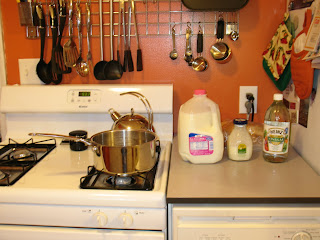
There are only three basic ingredients (two if you use whole milk) -- the milk, vinegar to curdle it, and some cream for better texture. If you want to, you can make it with just skim milk, with 2%, or with whole. You can use half and half instead of cream, or no cream at all if you don't have any. This recipe is not picky at all, but the basic proportions are a 1/4 cup white vinegar to a gallon of milk. Cream is "to taste" -- the more you add, the creamier your cheese will be, but even a couple of tablespoons will improve the texture, so don't worry if you don't have much.

There are only three basic ingredients (two if you use whole milk) -- the milk, vinegar to curdle it, and some cream for better texture. If you want to, you can make it with just skim milk, with 2%, or with whole. You can use half and half instead of cream, or no cream at all if you don't have any. This recipe is not picky at all, but the basic proportions are a 1/4 cup white vinegar to a gallon of milk. Cream is "to taste" -- the more you add, the creamier your cheese will be, but even a couple of tablespoons will improve the texture, so don't worry if you don't have much.

Subscribe to:
Posts (Atom)